ZKTeco — Enterprise Biometric Integration
Enterprise biometric integration platform connecting ZKTeco attendance hardware with payroll and workforce management systems. Designed for multi-tenant environments, asynchronous processing, and large-scale attendance synchronization.
Origin
Organizations relied on ZKTeco biometric devices to capture attendance records, but transforming raw device data into reliable payroll information presented significant operational challenges. Device firmware inconsistencies, unreliable network conditions, incomplete documentation, and large attendance volumes created synchronization and reporting issues.
The project involved building a complete integration platform capable of communicating with biometric devices, orchestrating attendance extraction, processing biometric events, synchronizing employee information, and delivering reliable attendance data to payroll workflows.
Most of the development was performed with limited vendor documentation, requiring extensive reverse engineering, experimentation, hardware testing, and production troubleshooting. Physical devices were connected to local development environments to validate behavior, reproduce edge cases, and improve synchronization reliability across multiple firmware versions.
Product Preview
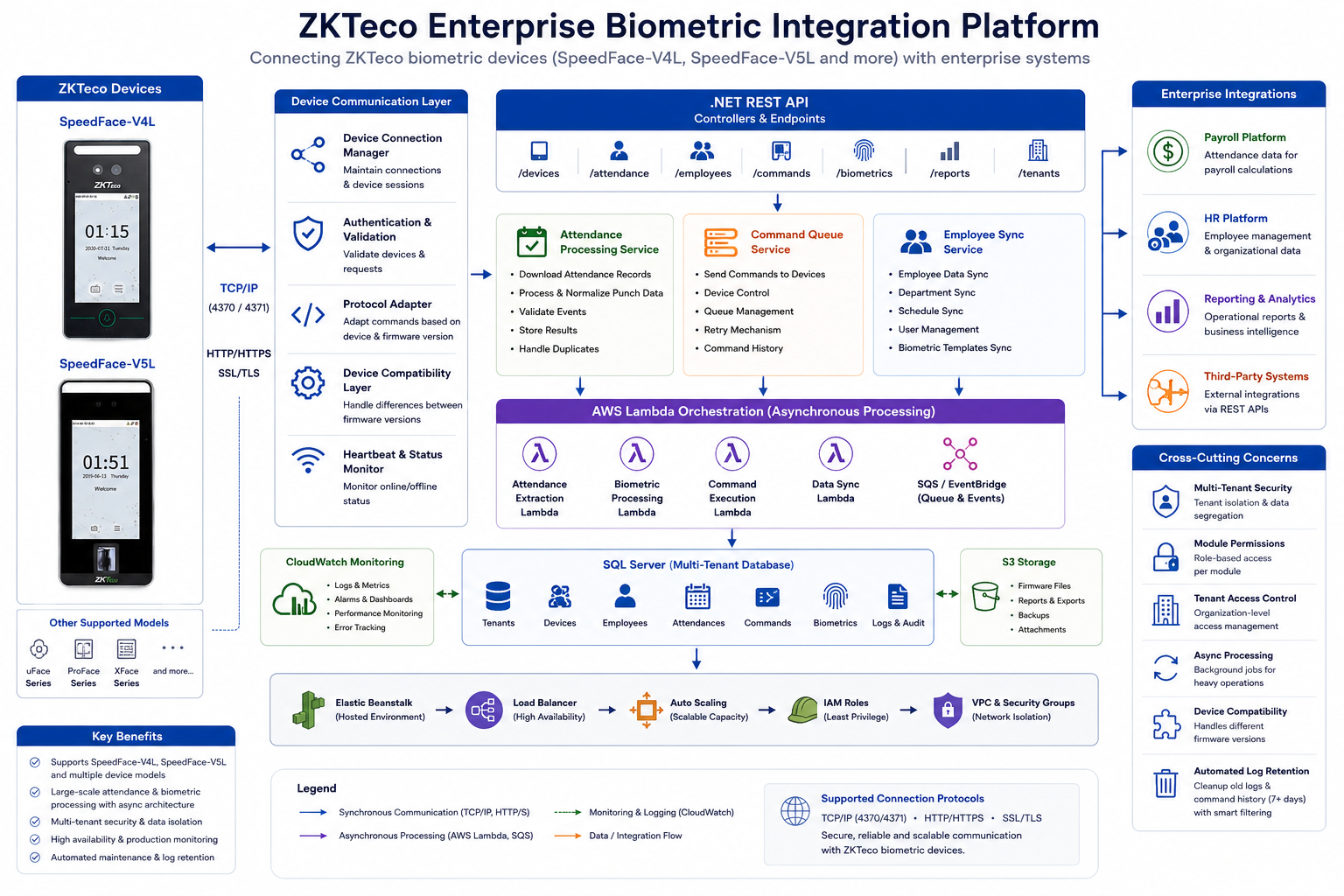
High-level architecture connecting biometric devices, processing services, and payroll systems.
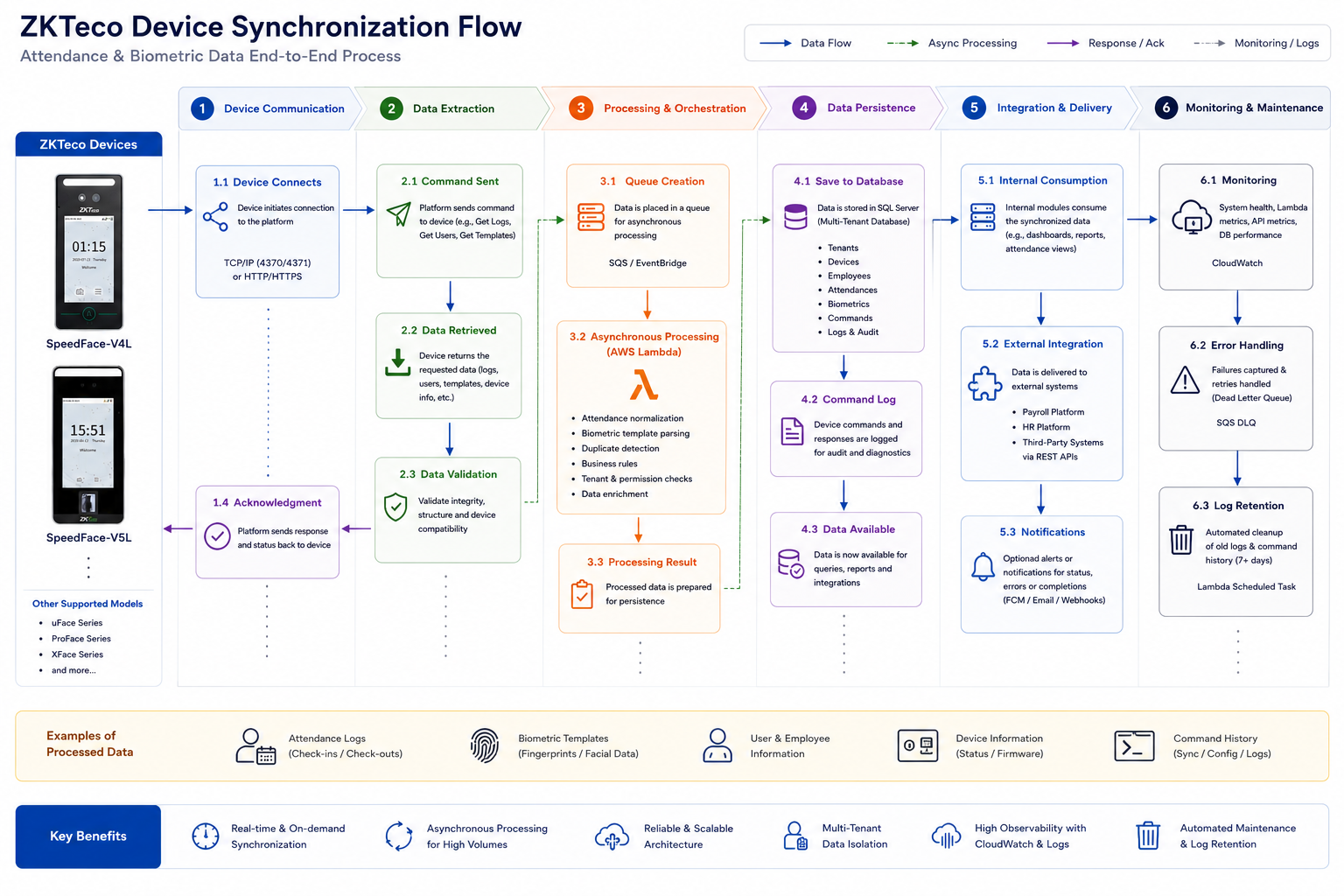
Attendance extraction and processing workflow across distributed devices.
High-level architecture connecting biometric devices, processing services, and payroll systems.
Attendance extraction and processing workflow across distributed devices.
Swipe to see more
Technical Challenges & Solutions
Hardware Integration with Inconsistent Firmware
Problem
ZKTeco devices exposed different behaviors depending on firmware version and model. Vendor documentation was incomplete and many commands behaved inconsistently across installations.
Solution
Built compatibility layers, validation mechanisms, and extensive diagnostic tooling to identify firmware-specific behavior. Used CloudWatch and Elastic Beanstalk logs to investigate synchronization failures and gradually improve support across multiple device generations.
Large-Scale Attendance Processing
Problem
Enterprise customers generated large attendance volumes and synchronization jobs that could block application workflows when processed synchronously.
Solution
Designed asynchronous processing pipelines using AWS Lambda orchestration. Heavy extraction and attendance processing workloads were delegated to background tasks, allowing the platform to remain responsive while processing large biometric datasets.
Multi-Tenant Authorization and Access Control
Problem
The platform served multiple organizations with different modules, permissions, and visibility requirements. Attendance information needed strict isolation between tenants.
Solution
Implemented tenant-aware authorization, module-based access control, and endpoint-level security validation. Built new controllers and APIs respecting organizational boundaries while maintaining a consistent architecture.
Database Growth and Operational Performance
Problem
Connected biometric devices generated hundreds of synchronization commands and operational logs daily. Large deployments experienced database growth and performance degradation.
Solution
Designed retention policies, automated cleanup processes, and filtering rules to remove unnecessary command history while preserving operational diagnostics. Optimized database usage and reduced pressure on large customer installations.
Production Diagnostics and Reliability
Problem
Many failures occurred only in customer environments and could not be reproduced locally. Device connectivity issues, network interruptions, and inconsistent device responses created difficult debugging scenarios.
Solution
Implemented structured monitoring using CloudWatch, Elastic Beanstalk logs, and operational diagnostics. This significantly improved incident investigation speed and enabled proactive identification of synchronization failures.
Extended Toolkit
Learnings
- Hardware integration projects require significantly more defensive engineering than traditional software-only systems because documentation and device behavior are often inconsistent.
- Asynchronous architectures become essential when processing large attendance and biometric datasets at enterprise scale.
- Production observability is a first-class engineering requirement; CloudWatch and structured logging dramatically reduced investigation time for customer incidents.
- Multi-tenant systems require security considerations from the earliest design stages rather than as an afterthought.
- Working directly with physical devices taught the importance of empirical testing over assumptions derived from documentation.
- Enterprise integrations succeed when operational reliability receives the same attention as feature development.
Technical Exploration
Research directions and engineering curiosity — not roadmap commitments.
Real-Time Device Monitoring
Explored approaches for proactive device health monitoring and synchronization anomaly detection.
Scalable Command Orchestration
Investigated event-driven processing models for improving large-scale command execution across distributed biometric device fleets.
Operational Analytics
Evaluated additional reporting and monitoring capabilities to improve visibility into attendance synchronization performance.